
Omnitracs One
Unifying twenty logistics applications into a single experience
Role
Lead UX/UI Designer — information architecture, navigation system, interaction patterns, responsive design
Timeframe
2020–2021
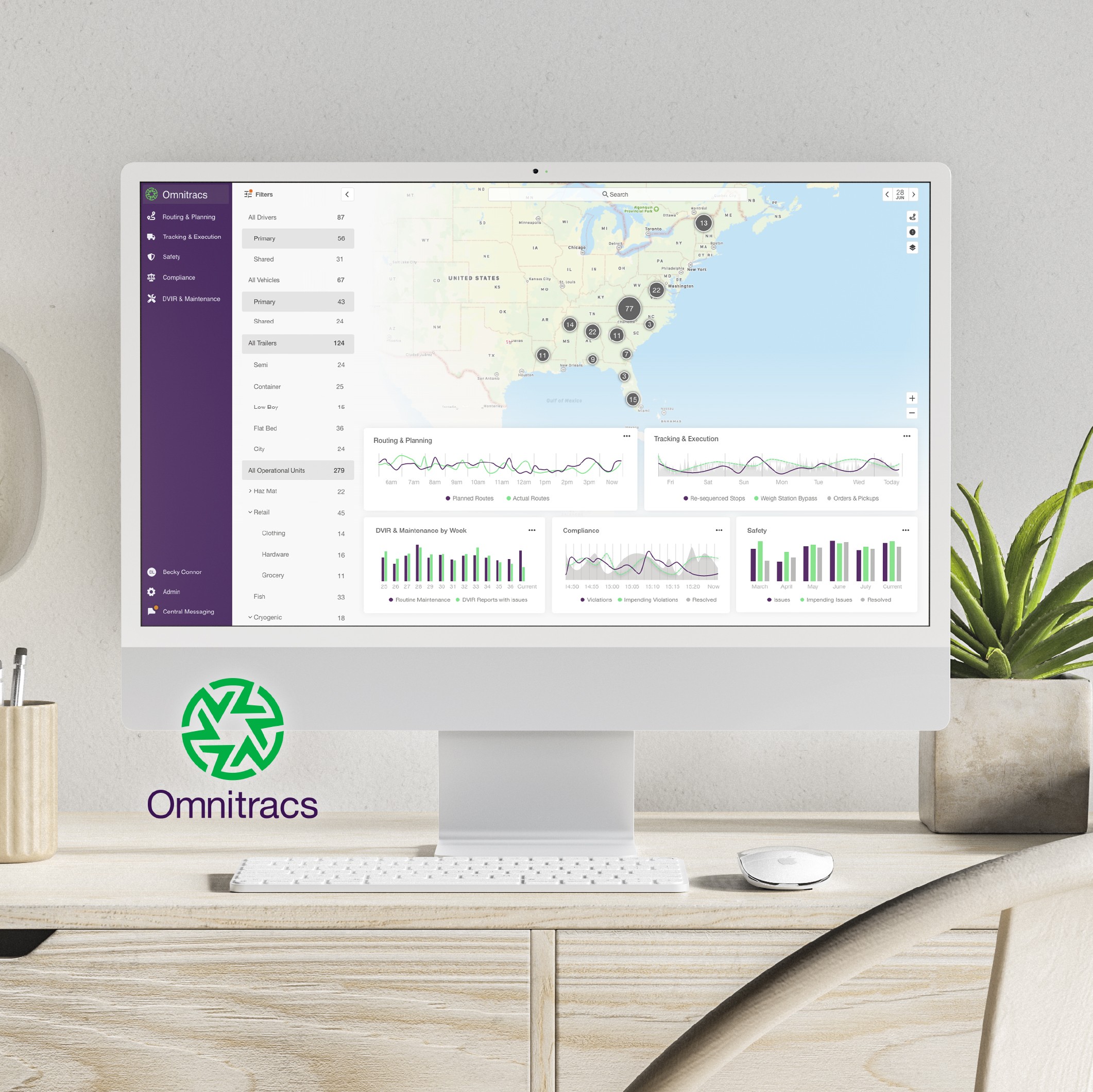
Unified navigation patterns across the Omnitracs One suite.
The vision
Omnitracs builds the software and hardware that lets a logistics company run an entire trucking fleet—every aspect of it, managed and regulated in one ecosystem. But that ecosystem hadn't been built in one piece. It had been assembled through years of mergers and acquisitions, each bringing another application into the suite.
The result was power without cohesion. The apps didn't share a language—navigation, patterns, and behavior differed from one to the next, so moving between them meant re-learning the software each time. Omnitracs launched an initiative to pull the whole suite into a single, unified experience: Omnitracs One.
My job was the hard center of it—how one person could navigate all that data, all those tasks, across all those apps, without needing a manual.
My role
I led the UX and UI for the unified experience: the information architecture that would hold twenty applications together, the navigation system, and the interaction patterns every app in the suite would conform to. The challenge wasn't designing one app well—it was designing a structure strong enough that twenty different applications could live inside it and feel like one product.
The hard part
When you're asking a user to absorb an entire logistics ecosystem, the worst thing you can do is invent something clever. Novelty is a tax—every unfamiliar pattern is something the user has to stop and learn.
So I built on the opposite principle: conventions are a gift. When a button looks like a button and navigation sits where people expect it, users don't have to think—familiarity does the work. Rather than design a new mental model, I borrowed one everyone already owns: the way we read a book. You skim the table of contents, choose a chapter, and drill into the page. General to specific, left to right.
That motion became the backbone of the entire system. I structured the whole experience into three tiers, so a user could enter anywhere and always know where they were. The landing view was a brief of the entire fleet's current status at a glance, every graphic a doorway into the feature areas represented in the global menu. Primary screens showed each division of the fleet in greater detail, with dashboards whose graphs linked directly to the features users checked most often. Task screens were where the actual work happened: filtering content and taking action on a single item or many at once. Every existing application in the suite conformed to this same pattern.
The navigation reinforced the reading metaphor physically. Top-level items ran across the top like chapter titles in a table of contents. Selecting one revealed the next level directly to its left—another skimmable list. Selecting again surfaced the actual information and the task-based actions tied to it. Left to right, three levels deep: one convention, learned once, that made the entire suite navigable. Because every app adopted the same three-tier logic and the same left-to-right movement, learning one part of Omnitracs One taught you all of it.
Outcome
The result was a unified information architecture and interaction model for Omnitracs One—a single navigational language spanning a twenty-application logistics suite across web and mobile. The core idea held throughout: the goal was never to make people learn a new system. It was to make a vast, complex platform feel like something they already knew how to use.
Outcome
The unified shell shipped to the full product line, cutting cross-app task time for dispatchers and giving the organization a shared design system that outlived the project itself.
Out of respect for client confidentiality, I've kept the visuals here minimal. The full navigation system, tiered screens, and interaction patterns are best experienced live—I'm happy to walk you through the depth in a conversation.