
CasePocket
Designing an AI-intake legal SaaS on constantly shifting ground
Role
Lead Product Designer
Timeframe
~1 year, discovery through design delivery
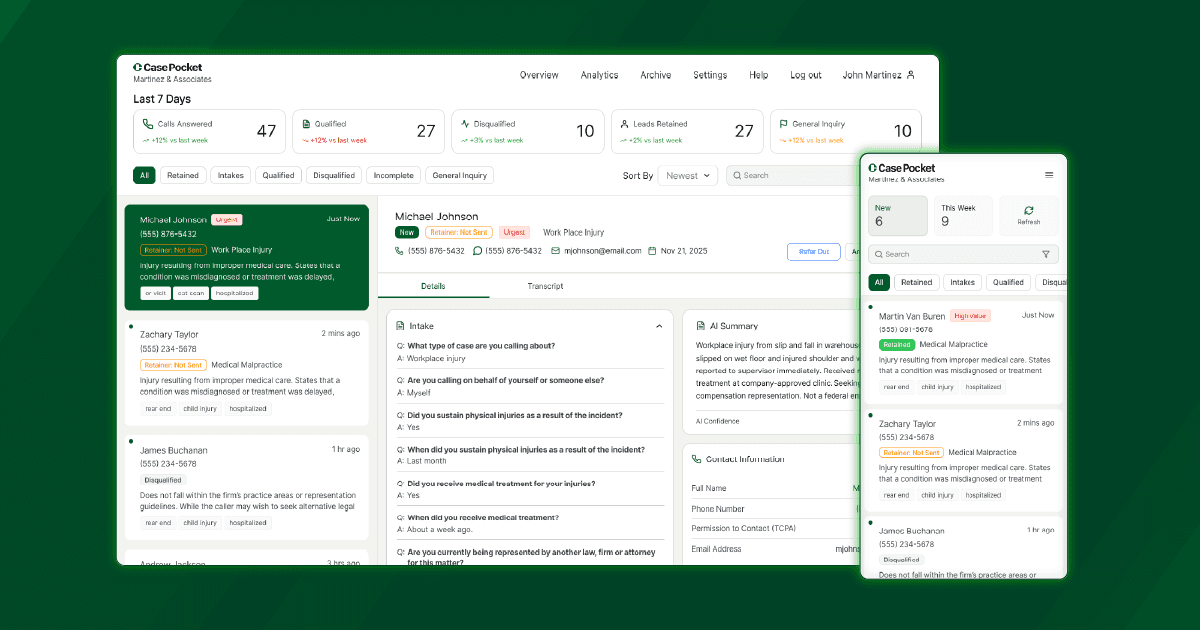
AI-intake-driven case management for legal teams
The vision
CasePocket began as a founder's conviction: legal intake was being transformed by AI, and the case-management tools built for that world didn't exist yet. The CEO had the technical and business thesis and a fifty-page technical report describing it. What the product didn't have was a form—something a person could see, use, and react to.
That was my mandate: turn a vision and a dense technical document into a product.
My role
I owned the product's design end to end. That meant the brand before the interface—messaging, value proposition, color, and identity—so the product had a point of view before it had a single screen. From there: requirements, a working prototype, a fully responsive design system covering every flow, and a year-long plan to bring it to market.
The hard part
The interesting challenge in CasePocket wasn't drawing screens. It was holding a coherent product together while nearly everything underneath it moved.
I started by actually reading the fifty-page technical report, then used ChatGPT to work it into a structured set of product requirements—translating engineering and business intent into something designable. From those requirements I built a prompt-driven concept in Figma Make, then refined it across roughly ninety iterations until it stood up as a working, presentable prototype.
Then the ground started moving. The AI-intake engine—the system feeding every case record—changed providers three times before the team ultimately built their own on Claude. Each switch reshaped the data returned from intake, which meant redesigning the data tables at the heart of the product to stay clean and legible no matter what the pipeline delivered. Midway through, the brand itself changed, and I carried that revision through the entire design.
The discipline that mattered here was absorbing all of that churn so the user's experience never showed the seams. The person using CasePocket should never feel that the intake vendor changed for the third time. That's the job.
Once the prototype was validated, I imported it into Figma and built it out properly: a responsive design system covering every possible flow, organized so it could scale and be maintained rather than redrawn. I also designed and built the product's marketing website to match the finished brand.
Outcome
The result is a complete, validated, fully responsive product design for an AI-intake-driven legal case-management platform—brand, prototype, data-table architecture, and every flow—paired with a year-long go-to-market plan. The design is delivered and implementation-ready.
Some details in this case study have been generalized to respect confidentiality agreements. Happy to walk through specifics in conversation.